- As climate change and deforestation increase fire intensity in Roraima, an all-women Indigenous fire brigade, the Pataxibas, are rising up to defend their territory.
- The Pataxibas are challenging gender norms while combining traditional ecological knowledge with firefighting, education, and reforestation.
- With support from Rainforest Foundation US, CIR is scaling this and other climate resilience strategies across the region.
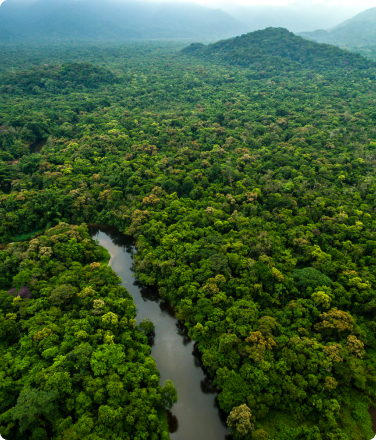
If you travel to the northernmost point of the Brazilian Amazon, you’ll land in a region that stands apart from the humid rainforests surrounding it. On satellite imagery, it looks dry and almost desert-like amid the sea of dark green — but on the ground, it’s teeming with life. The Amazonian savannas of Roraima, known locally as lavrados, are river-fed grasslands that cover approximately 70% of the Guiana Shield straddling Brazil, Guyana, and Venezuela, and are home to jaguars, giant anteaters, river dolphins, howler monkeys, and giant river otters, to name a few, in addition to nearly 300 bird species.
Roraima also has the highest percentage of Indigenous peoples in Brazil — around 58,000 people, comprising 15% of the state’s population. The state is home to the Macuxi, Wapichana, Taurepang, Ingarikó, Wai-Wai, Yanomami, Ye’kuana, Waimiri Atroari, and Sapará peoples, among others, who have stewarded the land for generations. Many are forest peoples, while others, such as the Wapichana and Macuxi, are peoples of the lavrado, whose cultures and land-management practices have evolved alongside its fire-adapted landscape.
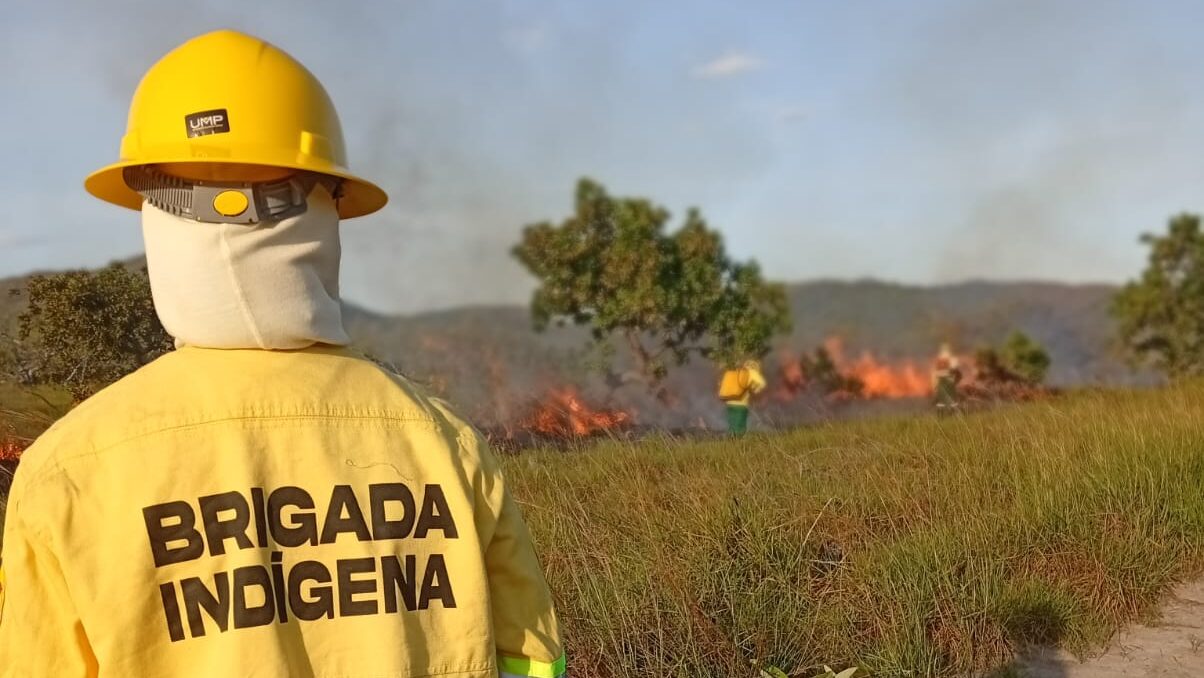
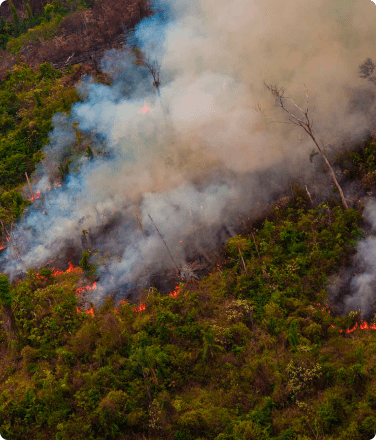
Every year following the rainy season, when the savannah still holds moisture, the Wapichana and Macuxi peoples exercise a form of ecological engineering through controlled burns, or “good fire.” The practice helps to maintain biodiversity, secure food, and reduce tall grasses that would otherwise become dangerous fuel later in the dry season. But as agricultural expansion encroaches on Indigenous territories and compounds with climate change, the natural defenses — such as stream corridors — that once kept fires in check are being undermined, making traditional fire management increasingly difficult.
As the landscape changes, so do Indigenous approaches to fire — and women are stepping up as the first line of defense. The Pataxibas, an all-Indigenous women’s fire brigade, are harnessing traditional burning practices, educating and accompanying their communities as they confront new fire risks, preserving and planting native seeds for land regeneration, challenging gender norms, and mentoring the next wave of young Indigenous leaders to build resilience in a changing climate.
Turning loss into leadership
Sineia Wapichana, coordinator of the Indigenous Council of Roraima’s (CIR) Territorial and Environmental Management and Climate Change Department (DGTAMC), still remembers vividly the massive fires of 1998 that changed everything: “We [practically] carried out a war operation to bring food, to bring seeds, to bring medicine, especially to the Baixo Cotingo region and other regions like Serra da Moça.” Many, she said, were left without food and had lost everything, “it all burned.”
Those fires continued unrestrained for four months, affecting around 30,000 people across 182 Indigenous communities in the state. “People had a lot of health problems,” Sineia told Rainforest Foundation US (RFUS) — smoke inhalation from the fires had left behind some serious cases of respiratory disease. The fires of that year were the result of a “super” El Niño, one of the most powerful on record at the time, which temporarily raised global temperatures by 1.5 degrees Celsius. Early modeling suggests another super El Niño is likely to develop in 2026 — which could bring similar, if not worse, levels of heat and drought to the region.
The 1998 crisis was what made Sineia, in 2012, decide to train as a firefighter, or brigadista, with Brazil’s National Center to Prevent and Combat Forest Fires (Prevfogo) — a program within the federal government’s environmental agency. She was one of the first Indigenous women to venture into a formal firefighter role at the time. Through her work at CIR — a close partner of RFUS for more than 20 years — Sineia has helped strengthen Indigenous-led fire response in Roraima, including access to training, protective gear, and essential equipment.
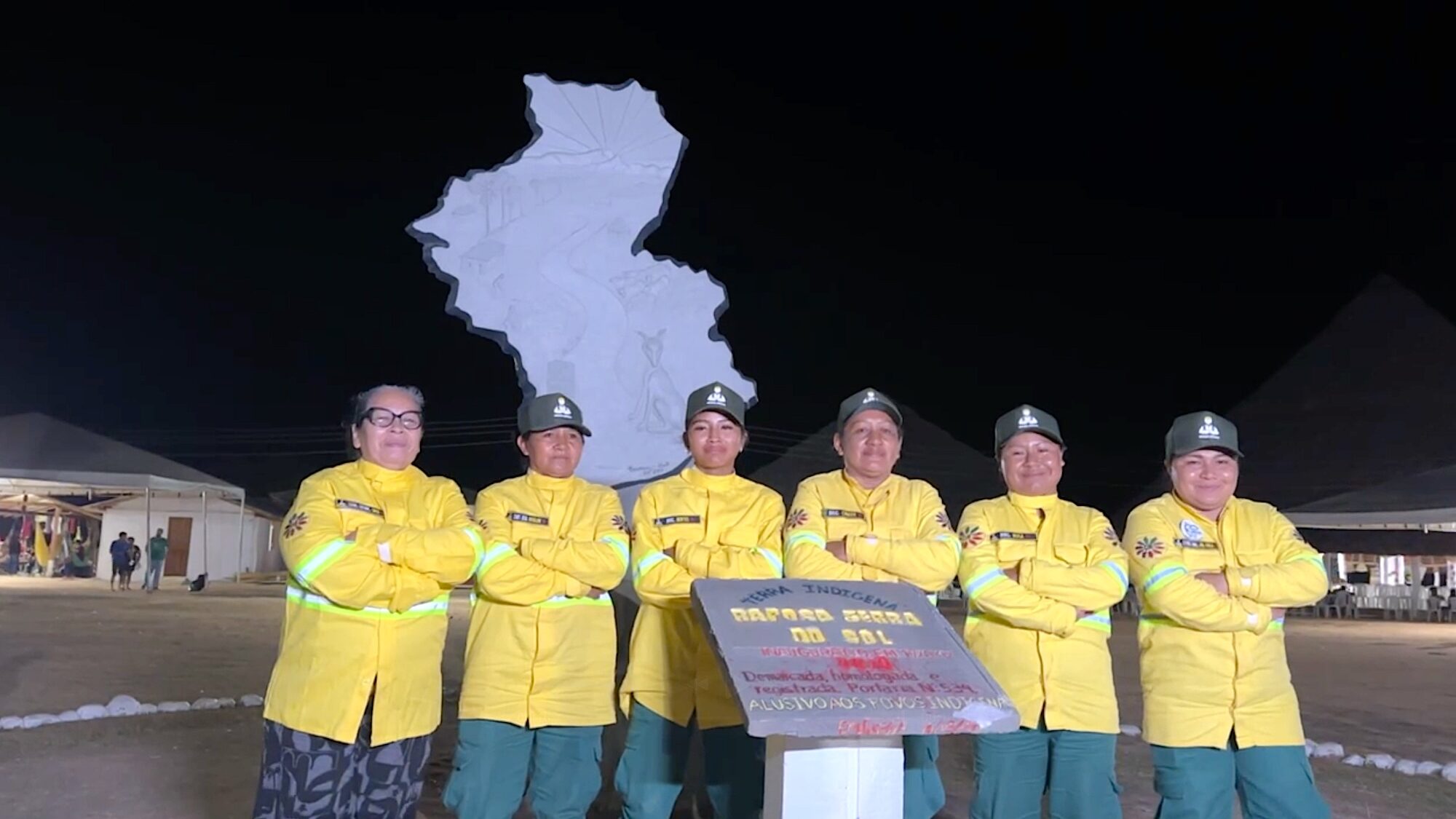
Today, with support from RFUS and other allies, CIR now coordinates seven Indigenous, community-led fire brigades in Roraima with over 200 trained brigadistas. Among them are the Pataxibas — or ‘yellow bees’ — an all women squad of 14 firefighters from five Indigenous territories. Their presence marks a shift from 1998, when women were largely absent from the frontlines. The brigades today are also better equipped, the product of a preparation decades in the making.
Facing the flames: The making of a brigadista
Ana Paula Levi da Costa, a Wapichana woman and leader of the Pataxibas, grew up in a farming community with the understanding that “there are two types of fire: one that destroys and another that restores.” In Serra da Moça, she often witnessed controlled burns as a child, explaining, “we’re born with a relationship with fire.” She remembers that whenever there was a fire, the whole community came together to put it out.
Even so, she didn’t see many women doing formal firefighting or prevention work. Before joining the brigade, Ana Paula was working as a security guard and studying to become a nurse technician. But her path changed when her cousin, one of the first Indigenous women to become a Prevfogo brigade chief in the region, leading 26 men, encouraged her to take the firefighter training. Despite being met with resistance from her family, Ana Paula took it upon herself to try.
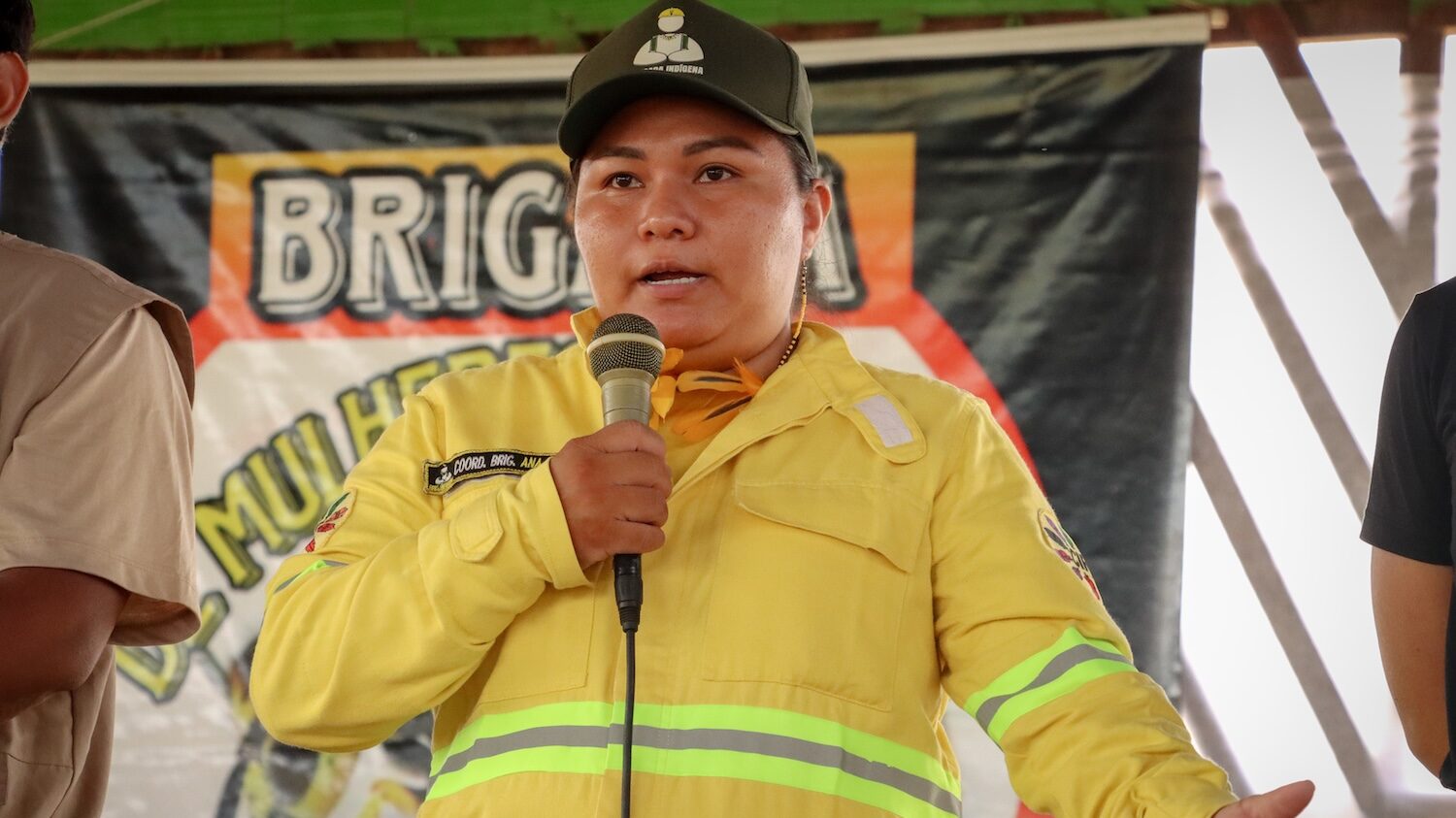
The training involves tests of physical aptitude and endurance, including walking approximately a mile and a half with a 24-liter pump full of water up to 80 lbs, in 30 minutes, and clearing a 160 square foot area of savanna with a machete or hoe in 24 minutes. Ana Paula failed the first time she tried, but remained committed and kept trying until she passed. She also learned to read the terrain and other signs of fire behavior, including changes in the color and density of smoke, to anticipate how a fire might move.
Fire doesn’t wait for you to have lunch. You eat lunch on a bed of ash, still hot.
– Ana Paula Levi da Costa, Wapichana woman and leader of the Pataxibas
In 2023, when major fires broke out in Roraima, Ana Paula was one of five women who climbed into the mountains with packed lunches to fight the flames in places with no road access. In some cases, brigadistas can work fighting fires for over five hours straight with barely any breaks.
“Fire doesn’t wait for you to have lunch. You eat lunch on a bed of ash, still hot,” she told RFUS. Though fire had always been part of her life, confronting it in its uncontrolled state was another matter. Through persistence and determination, she overcame that fear. “When you wear the uniform, it’s challenging, but it’s also a form of security, because you’re bringing protection not only to human beings, but also to the birds and the forest.” CIR’s community brigades also work alongside Prevfogo teams to rescue and transport injured wildlife to nearby rehabilitation centers whenever possible.
Building resilience that lasts
Beyond firefighting, CIR is developing broader climate resilience and adaptation plans. When not on the frontlines, the Pataxibas coordinate controlled burning schedules, lead environmental education in schools, and drive reforestation of burití palm forests through a seedling project in Serra da Moça.
This all feeds into DGTAMC’s work, led by Sineia, to scale Indigenous Adaptation Plans across Roraima and beyond — integrating monitoring, territorial governance, and land protection. With RFUS support, CIR has also built four climate resilience field bases uniting firefighters, territorial monitors, communication coordinators, and environmental agents.
We women know how to organize, we understand the needs, and we know how to value life. We do this out of love, because we know the need to take care of our land. If we don’t protect it, who will?
– Rosilene Bentes, Pataxibas squad leader
Through the work of the Pataxibas, Ana Paula hopes young girls will see that women are capable not just of facing the fire, but “of occupying any place, any space.” As Rosilene Bentes, a 53-year-old Pataxibas squad leader from the Sucuba community, put it during a Climate Adaptation and Resilience Exchange hosted by CIR with RFUS’s support: “We women know how to organize, we understand the needs, and we know how to value life. We do this out of love, because we know the need to take care of our land. If we don’t protect it, who will?”