Securing land tenure for Indigenous peoples is a proven strategy for protecting forests and reducing deforestation. Yet in practice, obtaining legal recognition of Indigenous territories in the Amazon remains slow, costly, and at times dangerous.
In Peru’s Amazon, the SI-TIERRA initiative—led by Indigenous organizations and supported by Rainforest Foundation US (RFUS)—is helping address these challenges by facilitating on-the-ground collaboration between communities and regional authorities. The report, Securing the Amazon: Indigenous Land Tenure and Forest Protection in Peru, co-authored by RFUS and the Inter-Ethnic Association for the Development of the Peruvian Rainforest (AIDESEP), examines this initiative in depth—highlighting how it addresses structural challenges in Peru’s land tenure system, the results it is delivering, and its potential to scale land tenure security across the region.
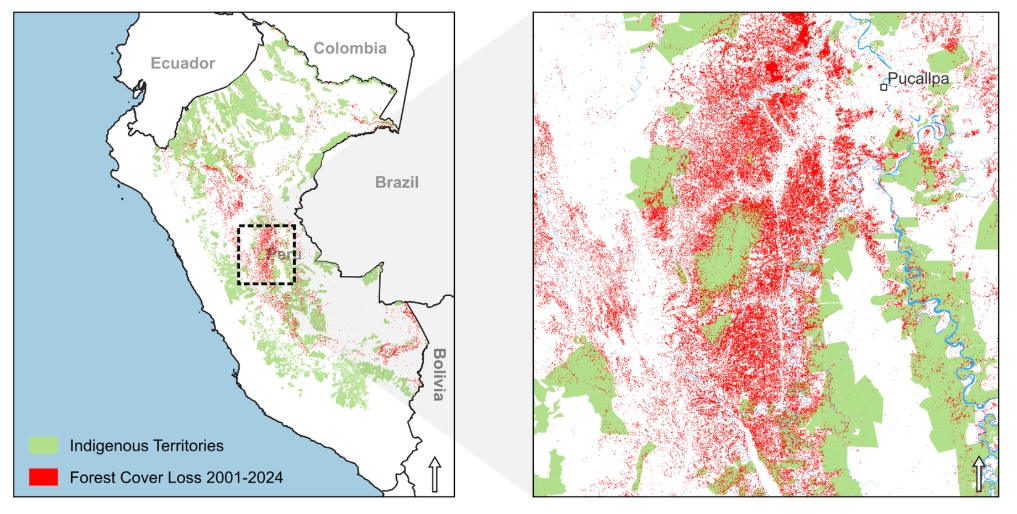
Across the Peruvian Amazon, an estimated 20 million hectares of Indigenous peoples’ lands remain without full legal security—an area larger than the state of Washington. Loreto, the region highlighted in this report, is the largest region in the Peruvian Amazon and a major center of this land-tenure gap. Without secure land tenure, communities face invasions, environmental degradation, and growing pressure from illegal activities.
Over the past decade, Peru has received substantial public and international funding for land tenure initiatives. However, progress has been uneven. By 2022, fewer than half of the 1,209 targeted communities had completed the full land titling process. Administrative complexity, overlapping land claims, and coordination challenges have reduced the effectiveness of many initiatives.
The report highlights the experience of SI-TIERRA, an Indigenous-led initiative coordinated by AIDESEP in partnership with regional authorities and supported by RFUS and partners. In Loreto, this approach has already advanced land tenure security for more than 40 Indigenous communities while reducing timelines from several years to approximately 8 to 18 months.
These findings show that when Indigenous leadership is combined with sustained field presence and political will, land tenure processes can move more efficiently and deliver more consistent results for communities and forest protection. Scaling approaches like SI-TIERRA could help accelerate land tenure security in Peru’s Amazon and beyond.

In Loreto, we have demonstrated
– Jorge Perez Rubio, President of AIDESEP
that coordination between Indigenous organizations and the Regional
Government can generate concrete progress in territorial legal security. The public-private collaboration model exemplified by SI-TIERRA is a
proven path that can be replicated and scaled across the Peruvian Amazon,
provided adequate funding and the necessary political will are in place.