Pushback from rights experts after aid-funded carbon certifier rejects first appeal from Indigenous group

Josh Lichtenstein, Program Manager at Rainforest Foundation US, expresses disappointment at the rejection of the appeal from the Amerindian Peoples Association of Guyana (APA) by carbon certifier ART. “The issues raised by APA’s complaint and appeal are serious and ongoing, and have, if nothing else, clearly demonstrated that the ART validation and verification process is deeply flawed, and the grievance mechanism does not work,” he says.
Amazon Summit Falls Short: Leaders Must Dig Deeper and Assume Deforestation Commitments

The final declaration of the Amazon Summit, referred to as the Belém Declaration, has fallen short of expectations for collectively implementing crucial measures to protect the Amazon rainforest, its peoples, and the global climate. It notably lacks a commitment towards zero deforestation by 2030 and fails to address halting oil exploration in the region. Read our full statement.
Indigenous Impacts of Carbon Offsetting Implementation in Guyana

In her latest article, Akola Thompson, advocacy coordinator at Guyana’s South Rupununi District Council, delves into the impacts of carbon offsetting on the Indigenous peoples of Guyana. She highlights the government’s persistent refusal to acknowledge Indigenous communities’ claims to their customary lands.
Questions Over Accounting and Inclusion Mar Guyana’s Unprecedented Carbon Scheme

Guyana has added almost all its forests to the carbon market, signing a $750 million carbon credit deal with petroleum company Hess Corporation, of which 15% will go to Indigenous communities. However, climate experts and Indigenous leaders are questioning the scheme’s accuracy in measuring carbon emissions and whether communities were properly consulted.
Indigenous Women Uniting to Fight for Their Rights and the Earth
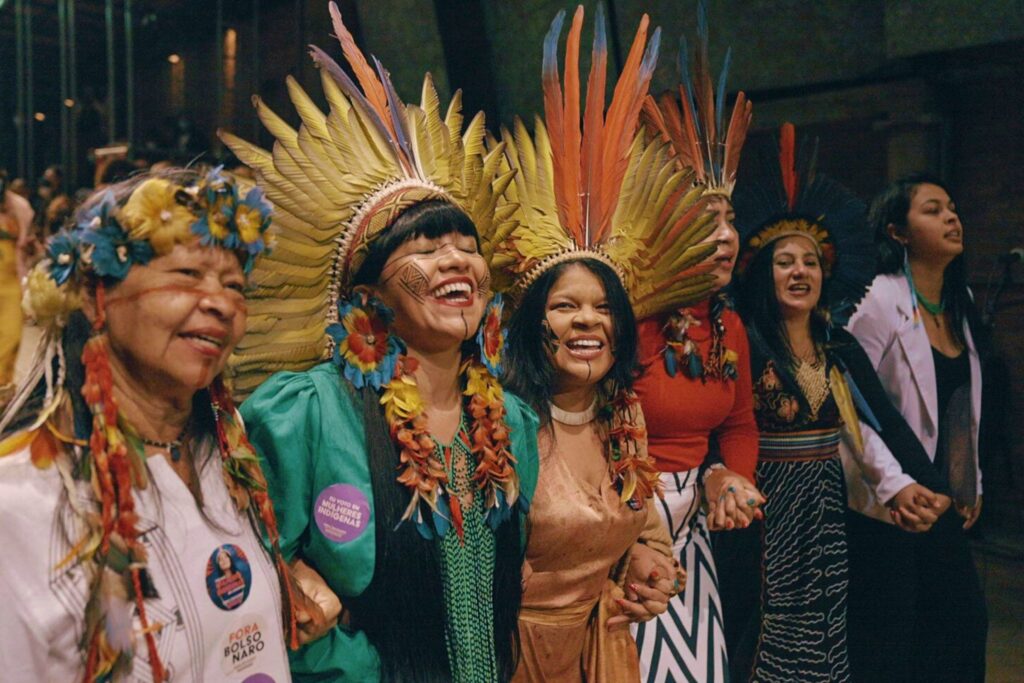
Indigenous women from rainforests around the world are uniting to fight for the health of the planet in their unique and powerful ways. Whether as activists, politicians, or mothers, they are bringing back ancestral knowledge and are determined to fight for their communities and the Earth.
Rainforest Foundation US 2021 Year in Review

As the year comes to a close, RFUS takes stock of the progress, victories, and lessons we learned in 2021.
Significance of Community-Held Territories in 24 Countries to Global Climate

New research shows indigenous peoples and local communities live on at least 3.75 million square miles of land spanning most of the world’s endangered tropical forests—yet have legal rights to less than half of these lands.
To Meet Guyana’s Climate Promises, Empower Indigenous Peoples

To blunt climate change, Guyana has pledged to aggressively expand the amount of rainforests protected within its borders. But as the threat of big oil looms, indigenous peoples’ land rights need to be recognized in order to meet this goal.
The UN’s IPCC Report: To Avoid the Worst of the Climate Catastrophe, Indigenous Peoples’ Rights Must Be Protected

Earlier this month, the United Nations’ climate change panel released a report stating that global warming will inevitably intensify in the coming decades. The only question is: By how much? Here, we lay out the role RFUS will play in mitigating the damage.
In Guyana, New Documentation of the Land Indigenous People Hold (and the Land They’re Unjustly Denied)

RFUS supported the Amerindian Peoples Association to conduct a nation-wide assessment of indigenous lands in Guyana. The report exposes inconsistencies and injustices in the land recognition process.