A Message From Our Executive Director
Dear Friends and Supporters,
This fall, the Rainforest Foundation US team gathered for New York Climate Week, joining roundtable discussions, speaking on panels, and connecting with partners and allies. We also co-hosted an event with CDP, Rights and Rainforests Are Climate Infrastructure, bringing together longtime supporters and new friends to explore what lasting rainforest protection requires at this important moment.
Throughout this quarter, we have been steadily advancing our 2030 goals in three strategic areas: land rights, territorial protection, and strengthening Indigenous institutions.
We’re proud to share that this season, RFUS is contributing to securing land titles for 50 Indigenous communities and counting across Peru’s Amazonian region of Loreto. The titles are a direct result of our ongoing partnership with the Interethnic Association for the Development of the Peruvian Rainforest (AIDESEP) and the government of Loreto. This work is supported by Rainforest Trust, Rainforest Fund, Wren, and the Stockel Family Foundation.
Even with legal recognition, communities must continue to defend their lands against illegal mining, logging, and other threats. RFUS supported the inauguration of two new community-led forest monitoring hubs, one in Brazil and another in Peru, to help communities detect these threats and coordinate their response.
We’ve also updated our website to feature a new page about our work strengthening Indigenous organizations. We start with each partner’s own vision of a strong, resilient organization, then provide the long-term support to help them get there. Be sure to check out our page to learn more.
None of this work would be possible without you. Thank you for your continued support.
With profound gratitude,
Suzanne Pelletier
Executive Director
Rainforest Foundation US
Program Highlights
Meet the All-Women Indigenous Firefighting Team Charting a Path for Climate Resiliency in the Brazilian Amazon
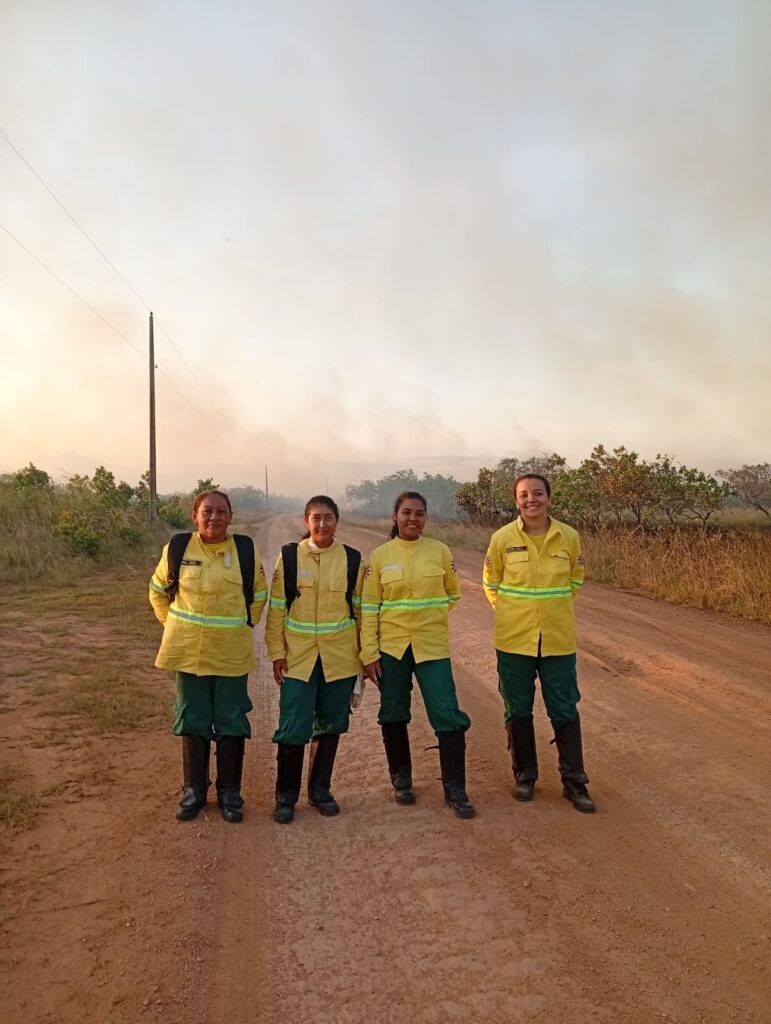
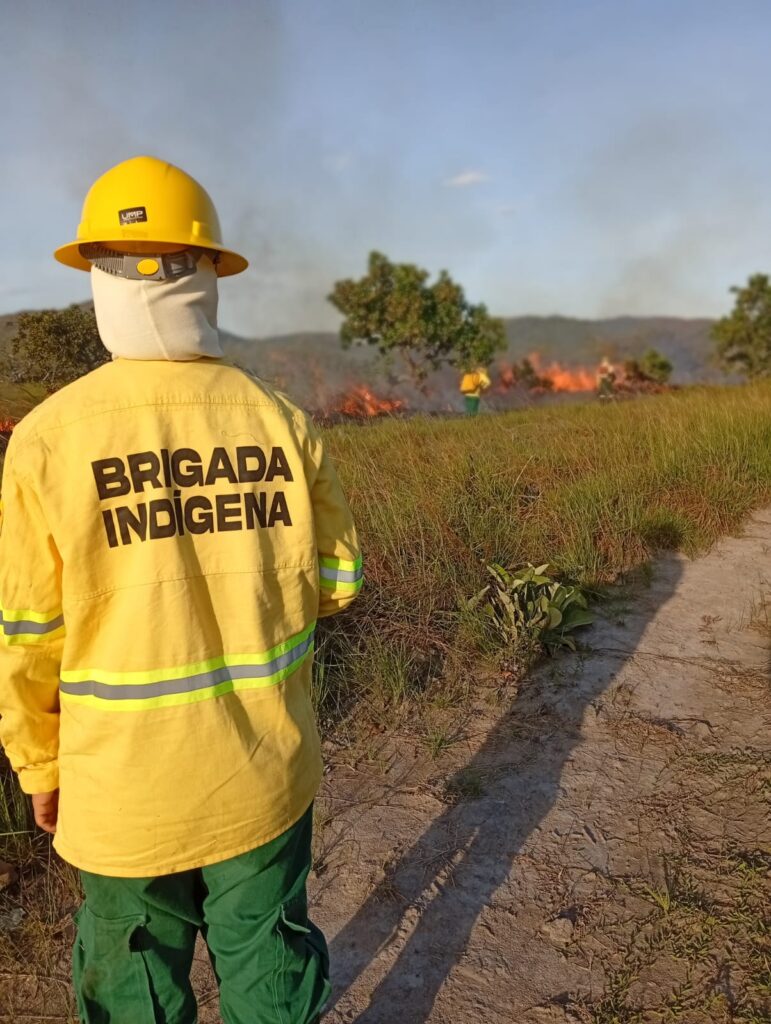
Members of the Pataxibas, an all-Indigenous women’s fire brigade in Roraima, Brazil. IMAGES: Indigenous Council of Roraima (CIR)
In Roraima, Brazil, the Wapichana and Macuxi peoples have long worked with fire as a land-management practice to adapt to a drier environment. But agricultural development, compounded by climate change, is undermining the natural defenses that once kept fires in check, making traditional fire management increasingly difficult. As the landscape changes, so do Indigenous approaches to fire — and women are stepping up as a first line of defense.
The Indigenous Council of Roraima (CIR)’s all-women’s fire brigade, the Pataxibas, are honing traditional burning practices, educating their communities, and regenerating the land, all while challenging gender norms and mentoring the next generation of Indigenous leaders.
“We women know how to organize,” said Pataxibas’ squad leader Rosilene Bentes. “We know how to value life. We do this out of love, because we know the need to take care of our land. If we don’t protect it, who will?”
Today, with support from RFUS and other allies, CIR coordinates seven community-led fire brigades with over 200 trained brigadistas, including the Pataxibas. Read more.
New Territorial Monitoring Hubs in Brazil and Peru
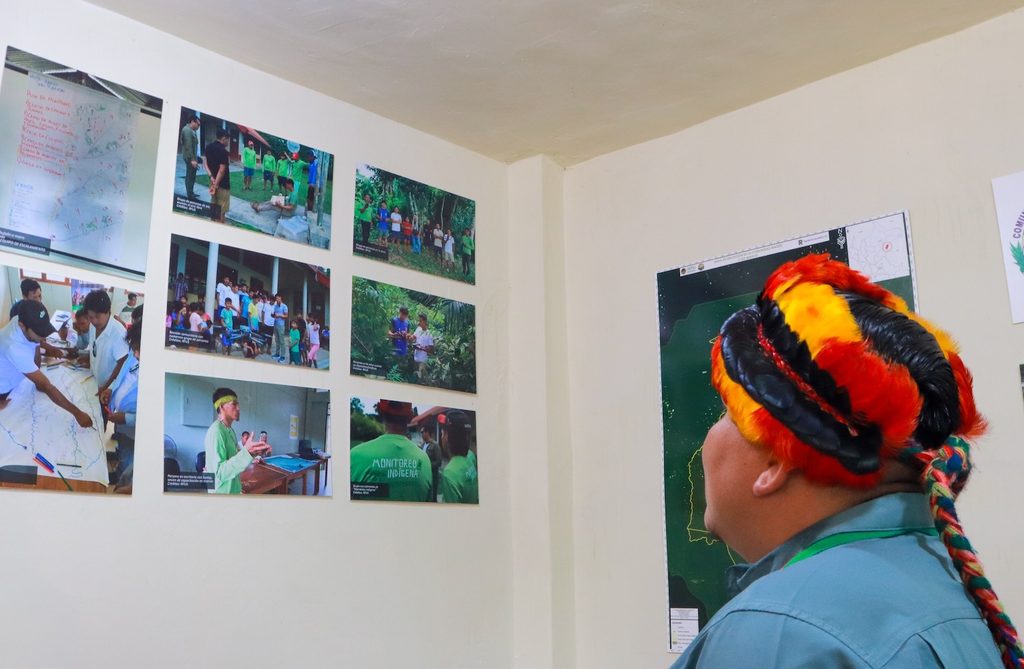
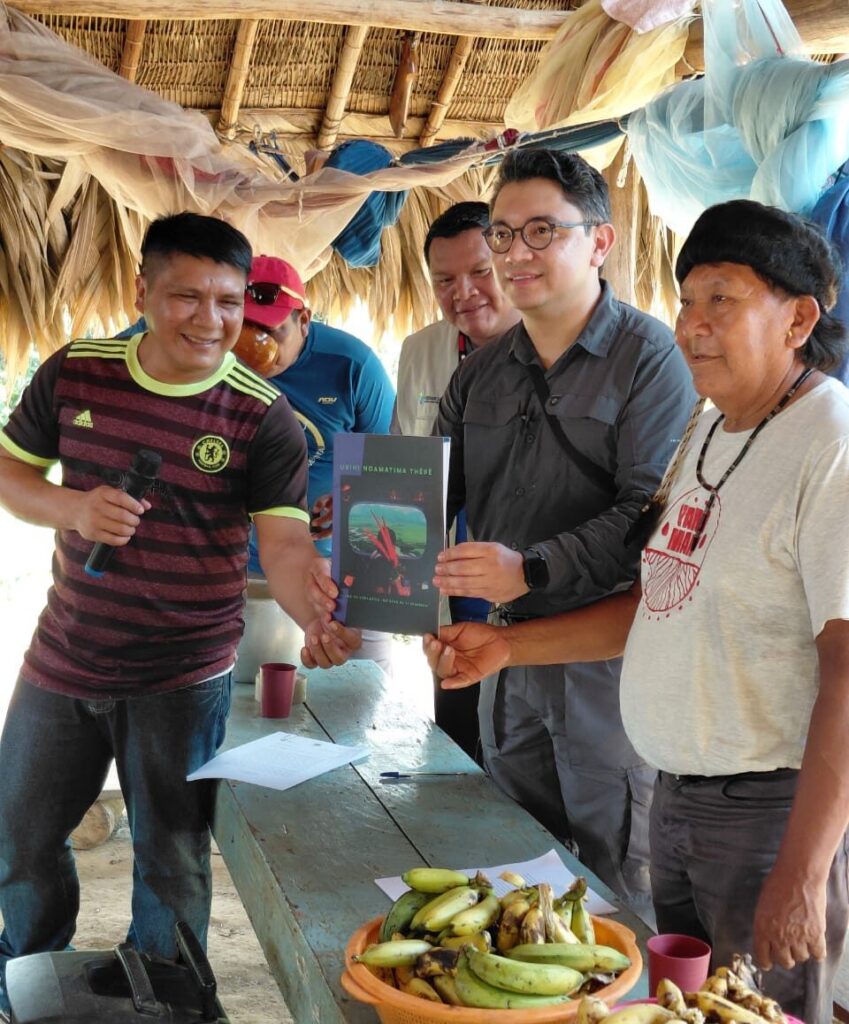
Left: An Indigenous leader contemplates photos of forest monitors at the Matsés monitoring hub, IMAGE: Marita Domper/ORPIO. Right: Edmilson Ye’kwana; Eloy Terena, Brazil’s Minister of Indigenous Peoples; and Yanomami leader Davi Kopenawa visit the Ye’kwana monitoring hub. IMAGE: Marilia Senlle/Seduume
RFUS supported the opening of two new community-led forest monitoring hubs: one in Brazil’s Yanomami territory, the other in Peru’s Matsés territory.
In Brazil, the Associação Wanasseduume Ye’kwana (SEDUUME) inaugurated the first of more than a dozen hubs planned across Yanomami and Ye’kwana territory. The hub provides a home base for community monitors to lead protection efforts for over two million acres using satellite data, drones, and field reporting systems. RFUS is supporting the hub with equipment, training, and stipends for the first group of 20 monitors.
In July, Brazil’s Minister of Indigenous Peoples, Eloy Terena, traveled to the remote community where the hub is located. He met with Yanomami leader Davi Kopenawa and SEDUUME leaders and pledged his support for the expansion of monitoring in Yanomami territory — an area heavily impacted by illegal gold mining.
In Peru, RFUS worked with AIDESEP and the Organization of the Indigenous Peoples of the Eastern Amazon (ORPIO) to open one of three planned hubs in the Matsés territory. The hub serves as the satellite information center for more than 70 monitors, allowing communities to act on deforestation alerts faster and strengthening the flow of data to the organizations that represent them.
Each hub marks an important milestone for its territory, though further funding is needed to equip and operate the remaining planned hubs.
Impact Insights
Forests Within RFUS’s Program Footprint Removed a Net 12.2 Million Tons of CO₂e in 2025
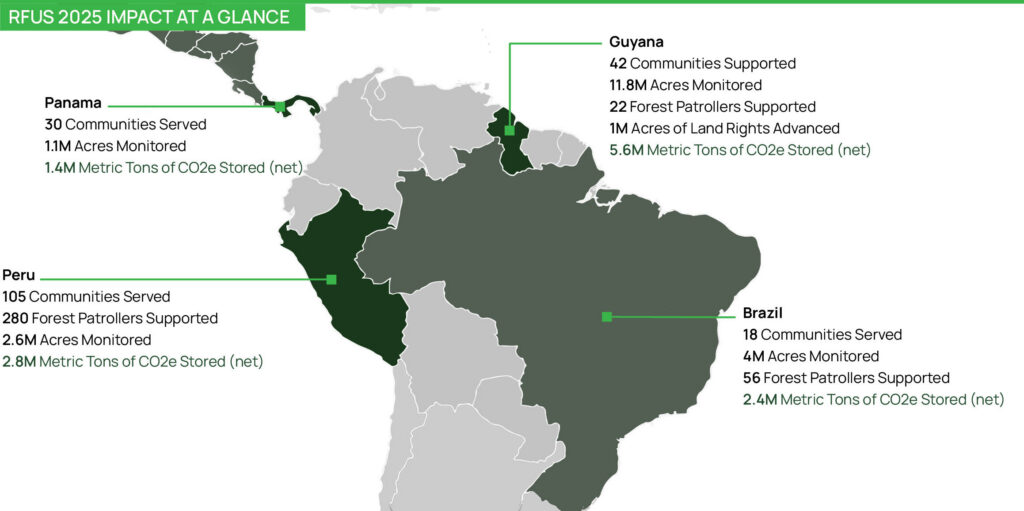
Forests within RFUS’s program footprint removed a net 12.2 million metric tons of CO₂e from the atmosphere in 2025 — up from 9.8 million tons in 2024. That’s roughly equivalent to the annual emissions of 2.8 million gas-powered cars, or the electricity use of 2.5 million American homes.
This is the main finding of our latest report on nature-based carbon sequestration, which outlines the climate benefits of forests where we support Indigenous partners. The amount of net carbon emissions sequestered is measured by calculating the difference between the amount of carbon forests absorb minus the greenhouse gases that are released through forest loss and degradation.
Two factors help explain the increase of sequestered carbon:
First, as detailed above, RFUS recently expanded its program footprint into two large, heavily forested Indigenous areas — the Matsés territory in Peru and the Yanomami territory in Brazil. Together, these encompass approximately 3.4 million acres of rainforest, which removed a net 2.3 million metric tons of CO₂e in 2025. The expansion of RFUS’s work and the inclusion of these new regions accounts for a significant part of the difference between 2024 and 2025.
Second, 2024 was an exceptionally severe year for fires in the Amazon. Yet, despite suffering higher-than-normal levels of fire-related forest loss, the Indigenous-managed areas included in RFUS’s program footprint in this region had less than half the deforestation compared to areas outside their territories. By 2025, forest loss in those areas had decreased to approximately its pre-2024 average.
These findings align with a growing body of research showing the climate benefits of secure land rights and Indigenous-led forest protection. A 2021 peer-reviewed study published in PNAS found 52% less deforestation in territories using RFUS’s Rainforest Alert monitoring methodology than in the control group.
“In both Peru and Brazil, these large intact territories exemplify the value of recognizing and protecting collective lands,” said Cameron Ellis, RFUS’s Field Science Director. “Their scale allows for maintained cultural connection to the landscape, which leads to better governance, management and overall resilience in the face of threats. This year’s carbon sequestration numbers reflect that forests are healthier when they are on securely held Indigenous lands.”

As we approach the end of the year, there are many ways to support Indigenous-led rainforest protection, including some tax-smart giving options you may not have considered.
On October 8, supporters across the country celebrated DAF Day, a national day encouraging people with donor-advised funds to put their charitable dollars to work for the causes they care about. If you have a donor-advised fund, you can recommend a grant to Rainforest Foundation US at any time. Your support helps Indigenous communities secure their rights, protect their forests, and safeguard our planet’s future.
In addition to DAF giving, there are many other tax-smart ways to protect rainforests and our climate as we head toward the end of the year, including gifts of stock, qualified charitable distributions (QCDs) from an IRA, and cryptocurrency. Learn more at www.rainforestfoundation.org/give, or reach out to [email protected] with any questions. We’d love to hear from you.