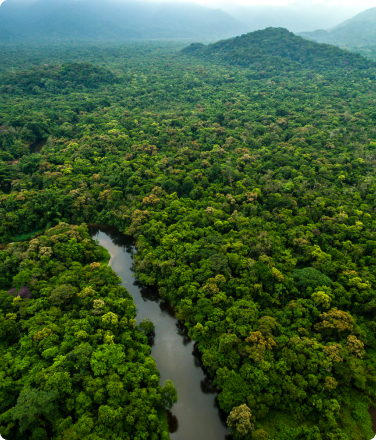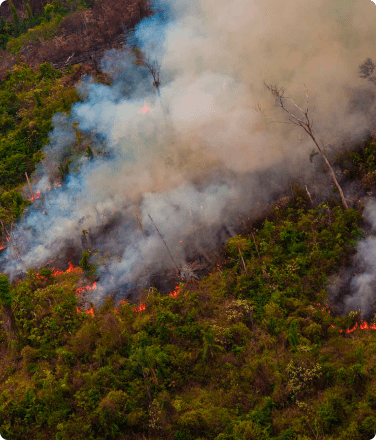
In 2025, the Brazilian Amazon experienced its lowest burned area since record-keeping began in 1985 — about 80% less than the nearly 40 million acres that burned in 2024. According to MapBiomas’ Annual Fire Report, approximately 7.7 million acres of forest burned. While still alarming, this represents a 78.5% reduction compared to 2024, when fires affected a combined area larger than the state of Florida, and became the leading cause of primary forest loss across the world’s tropical forests.
This decline was thanks in large part to more favorable weather following the end of El Niño-related drought, as well as environmental policy successes and an increase in federal and community-level firefighting efforts across the Brazilian Amazon. Yet this progress is fragile. Forecasters are watching the possible emergence of a “super” El Niño in 2026 — the same climate pattern that helped produce the historic drought behind the 2024 fires.
Early modelling indicates that fire activity is likely to increase across the Amazon, especially since the underlying pressures — agricultural expansion, illegal mining, and land-clearing fires — remain. Already, between the months of January and June of 2026, the Brazilian Amazon has seen over 2.7 million acres burned — 318,000 acres more than during the same period in 2025 — according to MapBiomas’ Fire Monitor.
Forecasts of hotter temperatures and drier conditions have put the Brazilian government and Indigenous communities on high alert. Meanwhile, deforestation levels in the Brazilian Amazon are at the lowest they’ve been in 10 years, according to Brazil’s National Space Agency (INPE). Between January and June 2026, a total of 320,000 acres of deforestation was recorded. In the same months of 2025, the total deforested area was 516,480 acres, marking a 38% decrease.
Building on over 35 years of steady, collaborative work with Indigenous partners in the Amazon and Central America, Rainforest Foundation US (RFUS) provides the tools, training, and resources to directly support partners in advancing land rights, expanding territorial monitoring, preventing and fighting fires, and strengthening their organizations.
Climate change is intensifying fire activity across the world, with extreme heat waves now five times more likely today than they were 150 years ago. Hotter temperatures dry out forests, creating ideal conditions for larger, more frequent forest fires. These fires release carbon from trees and soil, contributing to a “fire-climate feedback loop” that worsens climate change.
Extreme fires around the world have dramatically weakened the ability of the world’s forests to absorb carbon. In recent years, forests absorbed only about a quarter of the carbon they normally would in an average year, with 2023 marking the lowest level in over two decades. Fires became the primary driver of forest-related emissions during this period, releasing over four gigatons of greenhouse gases annually — over 2 times the usual amount.
Area Burned in Brazil’s Amazon between January and June
(2019–2026)
Tropical forests such as the Amazon are naturally humid and rarely burn. In the last few decades, however, two interrelated causes have driven Amazon fires to record highs: deforestation and drought.
Cattle Ranching & Agricultural Expansion:
Fire is commonly used to clear land for cattle ranching and agriculture: trees are cut, dried, and burned to prepare pasture or farmland. Land grabbers have also been found to exploit this, using arson to push into newly vulnerable areas without clearing and drying the forest themselves.
Drought:
Intensified by climate change, prolonged drought has fundamentally changed fire behavior in the Amazon. Tropical forests are naturally humid and rarely burn under normal conditions. But as rainforests grow drier, fires set for land clearing can now escape more easily into neighboring primary forest, where they may burn across thousands of acres. The 2024 Amazon fires were driven by a historic drought, fueled by El Niño.
Should these patterns continue alongside increasingly extreme climate events, scientists warn that more than half of the Amazon could be at risk by 2050, with devastating consequences for biodiversity and the stability of our planet.
Research consistently confirms that Indigenous peoples are the most effective forest stewards. Where Indigenous land rights are secure, forests are better protected from the deforestation and land degradation that make fire more likely to spread. Likewise, in 2024, over 87% of recorded fire hotspots in Brazil were outside Indigenous territories. Fires within Indigenous territories also tend to burn at lower temperatures, according to Global Forest Watch data, which is consistent with the controlled use of fire in traditional subsistence farming.
This does not mean Indigenous lands are immune to fire, especially during severe drought; fires set outside their boundaries can still spread in. But intact, well-protected forests are more humid and far less flammable than degraded ones.
The satellite map below displays real-time fires and Indigenous peoples’ lands. The majority of fires are observed outside Indigenous’ territories, typically stopping at their boundaries.
Cameron Ellis
Field Science Director, Rainforest Foundation US
From 2001 to 2024, forests in Indigenous territories across the Amazon absorbed an amount of carbon equivalent to France’s annual fossil fuel emissions, while surrounding non-Indigenous lands were collectively a net carbon source. Securing Indigenous land rights and ensuring communities have the resources to protect their territories are among the highest-impact, lowest-cost investments in sustaining the Amazon’s carbon sinks and biodiversity — and in turn, the future of our planet.
Discover the fascinating secrets of the Amazon!
Our new Kids’ Corner is full of new games, activities, and learning materials to help kids explore the rainforest—and see how they can help protect it.
CREDO Mobile is donating a portion of their revenue this month to three organizations, and Rainforest Foundation US is one of them!
The more votes we get, the bigger our share of funding to protect vital rainforest ecosystems.
Your vote is powerful and FREE.