Strong and Resilient Indigenous Organizations for Lasting Rainforest Protection
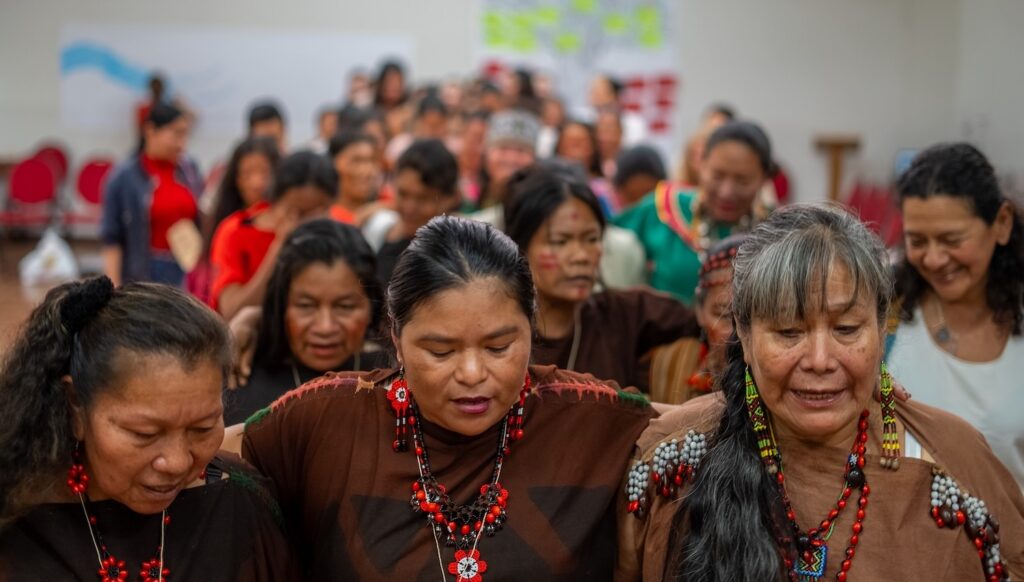
For nearly four decades, Rainforest Foundation US has worked alongside Indigenous peoples to strengthen their organizations and increase their control over the funding that sustains their work.
IMAGE CREDIT: Maribel Arango
Our Impact
28
Partner organizations currently receiving tailored support.
$10.5 million
Directed to Indigenous organizations in 2025*
57
Indigenous organizations strengthened since 1988
*Through joint grants, fiscal sponsorship, and support identifying and applying for funding directly.
Why Strong Indigenous Organizations Matter
Indigenous organizations turn the priorities of their communities into sustained action to defend rights and protect forests. To carry this work forward over the long term, they need to remain accountable to the people and territories they serve, be well-resourced in order to implement their plans, and stay resilient through adversity.
At Rainforest Foundation US, organizational strengthening is foundational to all our programs. We support Indigenous organizations to advance their own priorities, such as leading land rights processes, running community-based monitoring systems, defending forests against mounting pressures, and advocating for their rights — from their territories to the global stage.
“The APA greatly values the partnership and collaboration with Rainforest Foundation US. [Through their support] we were able to carry out activities that strengthened the capacities of Indigenous peoples in various areas and secured and preserved key aspects of Indigenous peoples’ rights.”
— Jean La Rose, Executive Director, APA
Our Approach
Our strengthening work is partner-driven, adaptive, and collaborative: we back our partners’ ownership as they set their goals, we tailor long-term support to their unique visions and facilitate connections with a broader network of peers and specialists.
Guided by these principles, we start with each partner’s own vision of a strong, resilient organization, then provide the long-term support to help them get there. The areas of support vary, but often include strategy, governance, financial management, operations, fundraising, and communications.
“Being effective in protecting rights and rainforests is not the same as being ready to meet donor requirements. Many Indigenous and territorial organizations remain outside the pool eligible for large direct grants. RFUS works to widen that pool—without asking organizations to become something they might not want to be.”
– Victor Gil, Capacity Strengthening Senior Program Manager, RFUS
Getting Funding to the Frontlines
Across climate philanthropy, there is growing recognition that more resources should reach the Indigenous peoples and local communities protecting the world’s rainforests. Yet major gaps still prevent funding from reaching many territorial organizations.
To be effective and durable, funding should bolster Indigenous organizations in ways that advance their goals and strengthen their long-term independence — not simply reshape them in order to fit donor requirements. RFUS acts as a bridge, helping climate funding reach a wider range of organizations without asking them to compromise their priorities or cultural contexts. This includes:
Developing joint grant proposals with longstanding Indigenous partners.
Supporting Indigenous-led territorial funds, which channel funding to organizations and communities within a shared territory under their own leadership.
Providing fiscal sponsorship when useful — managing the administrative burden of large grants on a partner’s behalf while they lead the work.
RFUS works from both sides to close the funding gap: helping partners build direct relationships with funders while standing alongside them to advocate for meaningful reforms to climate finance and carbon markets in global forums such as the United Nations. As direct donor relationships and Indigenous-led territorial funds grow stronger, more funding can flow directly to communities.
“Rainforest Foundation US was there at the beginning, when the Global Alliance of Territorial Communities began to build its governance, and they continue alongside us as a key player and our fiscal sponsor.”
— Juan Carlos Jintiach, Executive Secretary of the Global Alliance of Territorial Communities (GATC)
The Global Alliance of Territorial Communities is a political platform of Indigenous and local communities from Asia, Africa, and Latin America. Together they represent forest peoples in 24 countries, and protect more than 958 million hectares of tropical forests. Five territorial organizations make up the alliance: The Coordinator of Indigenous Organizations of the Amazon Basin (COICA), the Articulation of the Indigenous Peoples of Brazil (APIB), the Mesoamerican Alliance of Peoples and Forests (AMPB), the Alliance of Indigenous Peoples of the Archipelago (AMAN), and the Network of Indigenous and Local Populations for the Sustainable Management of Forest Ecosystems in Central Africa (REPALEAC).
COICA
Coordinadora de las Organizaciones Indígenas de la Cuenca Amazónica
Coordinadora de las Organizaciones Indígenas de la Cuenca Amazónica
The Coordination of Indigenous Peoples Organizations of the Amazon Basin is the largest representative organization of its kind in the region. It is made up of elected national indigenous peoples’ federations in all nine Amazon nations. In COICA’s long history, they have been on the frontline of the struggle to advance the respect for indigenous peoples’ rights and territorial security. RFUS has worked with COICA for many years, in specific collaborations with national federations such as AIDESEP in Peru and APA in Guyana, as well as with regional initiatives such as the Amazon Emergency Fund launched in 2020 to respond to the COVID-19 pandemic. COICA is also a leading member of the Global Alliance of Territorial Communities.
The Alliance of Indigenous Peoples of the Indonesian Archipelago is the largest indigenous peoples’ organization in the world, with millions of members in thousands of communities across Indonesia’s islands. AMAN has long been at the forefront of the struggle for indigenous peoples’ rights in Indonesia, and a leader in carrying the indigenous peoples’ rights agenda to the international level, including at the UNFCCC over the past decade. AMAN is also a leading member of the Global Alliance of Territorial Communities. RFUS is currently supporting AMAN’s emergency fundraising efforts around COVID-19 and forest fires.
The Coalition of Indigenous Peoples of Brazil was founded in 2005 and has since become the country’s largest Indigenous peoples’ federation, representing all of Rainforest Foundation US’s local and regional partners, like the Coordination of Indigenous Organizations of the Brazilian Amazon (Coordenação das Organizações Indígenas da Amazônia Brasileira, or COIAB). APIB is also a leading member of the Global Alliance of Territorial Communities.
REPALEAC
Réseau des Populations Autochtones et Locales pour la Gestion des Ecosystèmes Forestiers d'Afrique Centrale
REPALEAC
Réseau des Populations Autochtones et Locales pour la Gestion des Ecosystèmes Forestiers d'Afrique Centrale
Network of Indigenous and Local Populations for the Sustainable Management of Forest Ecosystems in Central Africa, part of the Global Alliance of Territorial Communities (GATC), is made up of indigenous peoples and local communities in eight Central African countries that influence the management and sustainable management of various ecosystems such as forests tropical and rangelands.
The Mesoamerican Alliance of Peoples and Forests is a Central American regional organization dedicated to promoting the rights of forest-dwelling Indigenous peoples and local communities. It is made up of national organizations who control significant areas of forests in the region. RFUS has worked with AMPB over the years to train community-based territorial monitors and mappers as well as to support regional and international advocacy. AMPB is also a member of the Global Alliance of Territorial Communities.
Coalition of Indigenous Peoples of Brazil is the umbrella organization representing all Indigenous peoples of Brazil. Since 2005, APIB has led Indigenous peoples’ resistance to policies and programs that threaten rights and lands. RFUS partners with APIB on global advocacy, among other work, as part of the Global Alliance of Territorial Communities.
Indigenous Council of Roraima is the main representative Indigenous organization in the northern Brazilian Amazon state of Roraima. RFUS has partnered with CIR for some 20 years providing legal, financial, and strategic support for the demarcation of Raposa Serra do Sol, and ongoing human rights advocacy and initiatives.
COIAB
Coordenação das Organizações Indígenas da Amazônia Brasileira
Coordenação das Organizações Indígenas da Amazônia Brasileira
The Coordination of Indigenous Organizations of the Brazilian Amazon, founded in 1989, is the largest regional Indigenous organization in Brazil. COIAB’s mission is to defend Indigenous peoples’ rights to land, health, education, culture, and sustainability, aiming at their autonomy through political articulation and strengthening of Indigenous organizations.
Hutukara Yanomami Association was established in 2004 to represent the Yanomami people of the northern Brazilian states of Roraima and Amazonas. RFUS worked closely with Hutukara in its early days, providing capacity strengthening for the organization as it spread its wings, as well as supporting a younger generation of leaders. We have also been active in a number of Yanomami-led campaigns and initiatives over the years.
Amerindian Peoples Association is the leading Indigenous organization in Guyana. APA has active members in over 60 Indigenous villages and regional representatives across Guyana, as well as a national secretariat in Georgetown. RFUS partners with APA in their efforts to advocate for land rights and expanded titling, national policy change, and to strengthen local and regional Indigenous governance institutions.
South Rupununi District Council is the representative body of the elected Chiefs (“Toshaos”) of the 21 Wapichan communities in southern Guyana. RFUS supports SRDC to acquire title to the collective Wapichan area, protecting the headwaters of Guyana’s major rivers, addressing mining threats and securing the border with Brazil.
North Pakaraimas District Council is the representative body of the Patamona and Macushi Indigenous peoples. The NPDC holds title to roughly 333,284 hectares of village land–26% of their ancestral lands. RFUS supports NPDC in mapping the lands outside village boundaries and to determine the best way to conserve these lands in the face of expanding mining operations and other threats.
MDC
Moruca District Council
MDC
Moruca District Council
Moruca District Council is the representative body of eight Lokono villages in a coastal lowland environment with extensive forest resources, mangroves and coastal wetlands. The eight titled villages cover roughly 31% of the traditional lands of the MDC. RFUS and APA have been supporting institutional strengthening efforts, including developing rules of procedure for Village Councils and guidelines for implementing Free, Prior, and Informed Consent.
UMDC
Upper Mazaruni District Council
UMDC
Upper Mazaruni District Council
Upper Mazaruni District Council is the representative body of the Akawaio Indigenous people. Communities in the Upper Mazaruni are engaged in a legal case to secure collective title for the full extent of their territory at Guyana’s High Court since 1998, while the government continues to issue mining rights to outside miners over untitled traditional lands subject to the case, without their Free, Prior, and Informed Consent (FPIC). RFUS has assisted the UMDC in monitoring and analysis of the extent of mining operations in the region.
Partners in Peru
AIDESEP
Asociación Interétnica de Desarrollo de la Selva Peruana
Asociación Interétnica de Desarrollo de la Selva Peruana
The Interethnic Association for the Development of the Peruvian Forest is the spokesperson organization for the Indigenous peoples of the Amazon in Peru, which works for the defense and respect of their collective rights. AIDESEP has 109 federations that represent 1,809 communities where more than 650,000 Indigenous men and women live, grouped into 19 linguistic families.
ORPIO
Organización Regional de los Pueblos Indígenas del Oriente
Organización Regional de los Pueblos Indígenas del Oriente
The Organization of the Indigenous Peoples of the Eastern Amazon is the Indigenous peoples’ representative organization in the Amazonian department Loreto, Peru, representing 430 communities. ORPIO engages in protecting their territories, promoting human development, and defending their rights and Indigenous governance.
The Regional Organization Aidesep Ucayali represents 15 Indigenous peoples, 13 subnational federations. ORAU engages in promoting the economic, social, political, and cultural development of the Indigenous peoples that it represents.
The Mesoamerican Alliance of Peoples and Forests is a Central American regional organization dedicated to promoting the rights of forest-dwelling Indigenous peoples and local communities. It is made up of national organizations who control significant areas of forests in the region. RFUS has worked with AMPB over the years to train community-based territorial monitors and mappers as well as to support regional and international advocacy. AMPB is also a member of the Global Alliance of Territorial Communities.
CGTCEWP
Congreso General de Tierras Colectivas Embera y Wounaan de Panamá
Congreso General de Tierras Colectivas Embera y Wounaan de Panamá
The General Congress of the Embera and Wounaan Collective Lands of Panama is the representative body for the Embera and some of the Wounaan communities outside of the Embera Wounaan Comarca, and has been at the forefront of the struggle for land rights for many years.
National Congress of the Wounaan People is the representative body of the Wounaan people inside and outside of the Comarca, with elected leaders who fight for the Wounaan at the national level. The CNPW has an associated Wounaan Foundation which is the project management arm of the Congress.
COONAPIP
Coordinadora Nacional de Pueblos Indígenas de Panamá
Coordinadora Nacional de Pueblos Indígenas de Panamá
National Coordinating Body of Indigenous Peoples in Panama is the national umbrella representative organization of Panama’s Indigenous peoples’ organizations founded in 1999 to lead the fight for Indigenous land rights, respect for Indigenous culture, and other priorities.
TNGC
Consejo General Naso Tjër-Di
TNGC
Consejo General Naso Tjër-Di
The Naso Indigenous people live in Panama and Costa Rica, currently primarily along the Teribe River in the Bocas del Toro province of Panama. The Naso number a little over 4,000 people, and against enormous odds have preserved their language, culture, and way of life. Their traditional lands cover some of the most mountainous and biodiversity-rich areas of western Panama.
The Tule General Congress of Tagarkunyala represents the Guna people in the communities of Paya and Pucuru, and the large territory considered the ancestral homeland of the Guna people, including the sacred mountain of Tagarkunyal. The Tagarkunyal territory is completely inside the Darien National Park, making them a key ally for the sustainable management of Central America’s largest protected area.
Discover the fascinating secrets of the Amazon! Our new Kids’ Corner is full of new games, activities, and learning materials to help kids explore the rainforest—and see how they can help protect it.