By Maryka Paquette and Joshua Lichtenstein
When governments gather in Antalya, Türkiye for COP31, much of the attention will be on the negotiations: what countries agree to and whether their commitments meet the scale of the climate crisis. Rainforests are among the world’s most essential climate infrastructure, and their protection is an urgent part of that agenda. But many decisions shaping their future are already being made in less visible settings — within the institutions that set the terms of forest finance and determine how it reaches the communities protecting those forests.
Over the past year, Indigenous peoples and local communities have worked to influence those decisions. Their organizations have reviewed technical proposals, brought concerns from their territories to the international debate, and pressed for changes in how forest finance treats their rights and priorities. That work has helped strengthen a leading jurisdictional forest carbon standard, TREES, and shape a dedicated financial allocation under the Tropical Forest Forever Facility (TFFF).
These gains took years of organizing and negotiation, and they deserve recognition. But much still depends on how these changes are put into practice, and whether communities see the benefits in their territories.
Many of the government officials and heads of state arriving at COP31 also oversee forest programs, fund financing institutions, or sit on their boards. They must use that influence to ensure these mechanisms respect Indigenous peoples’ and local communities’ rights and allow them to receive and manage funding through their own institutions.
Stronger requirements in forest carbon markets
The REDD+ Environmental Excellence Standard, known as TREES, sets requirements for forest carbon credits generated by programs covering countries or large jurisdictions. It is administered by the Architecture for REDD+ Transactions (ART), and its requirements help determine what participating governments must demonstrate before credits can be issued.
For communities whose territories fall within these programs, the details matter. What information must a government disclose? When must it seek consent? Who decides how revenues are shared? What happens when communities raise concerns?
A coalition of Indigenous and local community representative organizations and allies brought these questions to the review of TREES 2.0, with technical support from Rainforest Foundation US and Rainforest Foundation Norway. Their recommendations drew on experience with programs in their countries, including difficulties obtaining information and participating in decisions that affected their territories.
The revised standard, TREES 3.0, includes stronger requirements for free, prior and informed consent (FPIC) where REDD+ activities affect community rights, lands, resources, or livelihoods. It also introduces a distinct benefit-sharing requirement, including a process for agreeing to arrangements before carbon proceeds are distributed or used as well as reporting on how benefits are distributed.
Other changes address some of the practical obstacles to participation. Public comment periods have increased from 30 to 60 days, and participating governments must now explicitly notify stakeholders of document availability and the opportunity to comment, in line with the safeguards. Key documents must be provided in additional languages used for government operations in the program area, although this still falls short of requiring all Indigenous or local languages.
These provisions are designed to give communities more time, information, and stronger grounds for insisting that their rights be respected. Their usefulness will depend on how governments implement them and how auditors assess compliance. A documented benefit-sharing agreement, for example, must be backed by the evidence that communities could meaningfully shape its terms and that benefits are distributed as agreed.
Independent auditors therefore have an important responsibility to examine what happened in practice. Carbon credit buyers should scrutinize those findings, including how concerns raised by communities were addressed, before purchasing ART credits.
A dedicated allocation within TFFF
Another policy effort has focused on TFFF, launched under Brazil’s leadership at COP30 in Belém. The Facility is designed to generate long-term payments to tropical forest countries to keep forests standing.
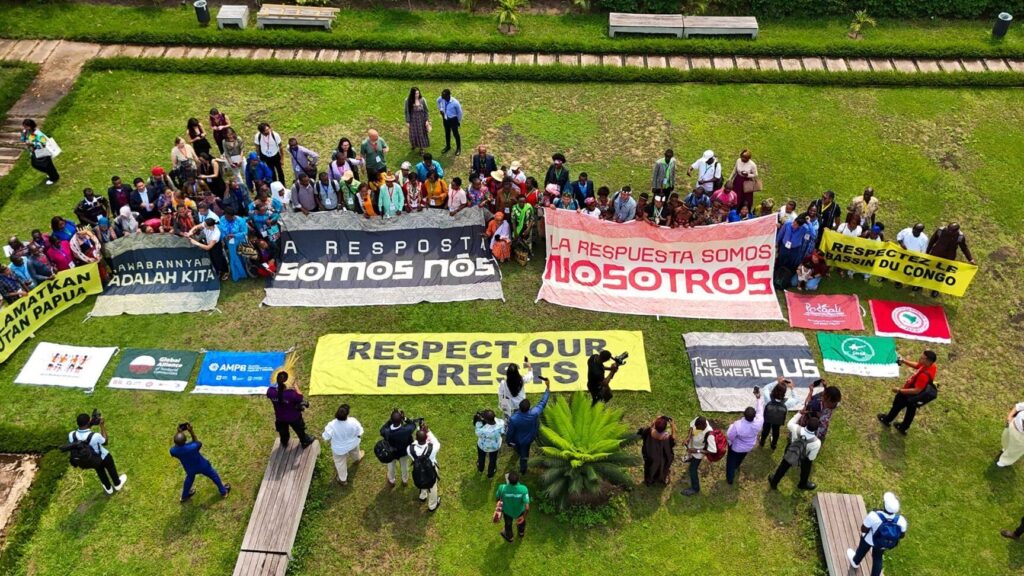
The Global Alliance of Territorial Communities (GATC) has helped lead the co-design of TFFF’s dedicated allocation alongside a Global Steering Committee that brings together Indigenous peoples and local community representatives as well as their territorial funds to advise on a new direct finance mechanism. Together, they have worked with Brazil, the World Bank, and other participating governments to ensure it meets the needs of community-led territorial investments.
A central achievement was the commitment to direct at least 20% of participating countries’ forest payments to Indigenous peoples and local communities. Included in the Facility’s launch in 2025, that minimum allocation was formally incorporated into the TFFF Charter in 2026.
The co-design process also advanced arrangements for national steering committees and community-selected executing agencies, including territorial funds, to govern and manage the allocation.
In September, the TFFF Board’s co-chairs formally invited the Global Steering Committee to advise the Board and nominate a representative to participate in their meetings until the permanent Indigenous peoples and local communities Advisory Council is established.
Having a formal channel for community input while the operational rules are being developed is an important gain, even if the role is limited to an advisory one. Meanwhile, the arrangements for communities to receive funding directly still need to be adopted by the Board, and it remains uncertain how much financing TFFF will ultimately deliver.
Building on territorial funds
Communities have already built institutions that could help channel TFFF’s minimum 20% allocation to their territories. A joint GATC–RFUS report mapping community-led financing mechanisms across 26 tropical forest countries documents how territorial funds enable communities to receive resources and decide how they are used through their own governance systems.
For communities, forest protection is ongoing work, sustained by strong organizations and the well-being of the people who live in their territories. Funding may support forest monitors or land rights advocacy, but communities may also prioritize sustainable livelihoods, leadership development, or other needs. Community leaders and members are best placed to make those decisions. Predictable financing would give them room to plan beyond short grant cycles and respond as their priorities and conditions change.
Yet many territorial funds remain small and dependent on limited donor contributions. Making direct access work will require sustained support for existing funds and locally appropriate options where funds are not yet established.
Turning the new rules into reality
These mechanisms depend on the integrity of the governments and institutions implementing them. As world leaders gather for what COP31 President Murat Kurum has promised will be a “COP of implementation,” putting these new rules and commitments into practice will require action from several quarters:
- Governments implementing TREES programs must respect FPIC, give communities a meaningful role in program design and benefit-sharing, and ensure access to effective grievance mechanisms, among the other safeguards.
- Independent auditors and carbon credit buyers must follow through: auditors by verifying that rights are respected, and buyers by examining those findings before purchasing.
- The TFFF Board and participating governments must respect the autonomous governance of Indigenous and local community stakeholders and create workable funding routes to their selected institutions.
Indigenous peoples and local communities have shown unwavering resolve in pushing to change the rules so that financing can better support the work they have sustained for generations. Governments and financing institutions must now follow through, enabling communities to receive and direct reliable funding according to the priorities they set from the ground up.
Keeping forests standing and avoiding deforestation depends on sustaining the people who live in and care for them. We can no longer afford to underfund the communities protecting our most valuable climate infrastructure.