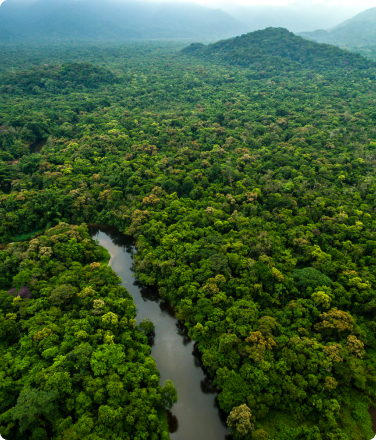
- Indigenous peoples are the most effective protectors of tropical forests, which are critical carbon sinks and biodiversity strongholds. These forests are threatened by severe fires, drought, criminal activity, and the rollback of climate and environmental policies.
- RFUS is supporting our Indigenous partners to protect their forests through land titling, community-led forest monitoring, and capacity-strengthening.
- With the Amazon nearing a tipping point, this moment is critical, and RFUS’s year-end match means supporters can double their impact to support Indigenous communities to keep rainforests standing.
As we near the end of 2025, an urgent truth continues to drive our work: Without tropical forests, we have no future.
Rainforest Foundation US (RFUS) has long supported Indigenous partners across the Amazon basin and Central America’s rainforests. It has been proven time again that Indigenous peoples are the most impactful defenders of rainforests and the extraordinary biodiversity living within them.
Research shows that forests under Indigenous stewardship experience lower rates of forest loss than any other protection model, especially when communities hold legal title to their ancestral lands.1 2 Indigenous-managed forests are also proven to store more carbon than other forests in the Amazon, whereas many public and privately managed forests often struggle to maintain their ecological balance and can even become sources of carbon emissions. From 2001-2021, forests managed by Indigenous peoples stored a net 340 million tonnes of carbon dioxide from the atmosphere each year, equivalent to the U.K.’s annual fossil fuel emissions.3
The evidence is clear: These rainforests are essential to life on Earth. They are biodiversity strongholds and are some of our planet’s most powerful carbon sinks, and it is Indigenous peoples who are keeping them standing. Yet from rampant forest fires to a repeatedly delayed transition away from fossil fuels, the world’s tropical forests, Indigenous peoples’ ancestral homes, and our shared future are being pushed quickly toward crisis.
Why This Moment Matters More Than Ever
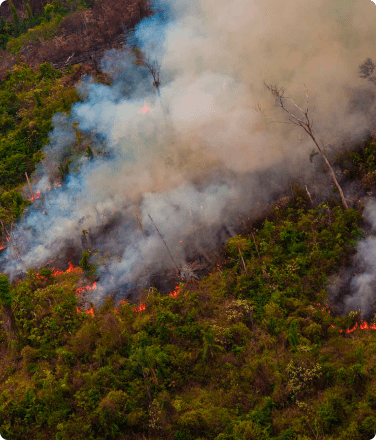
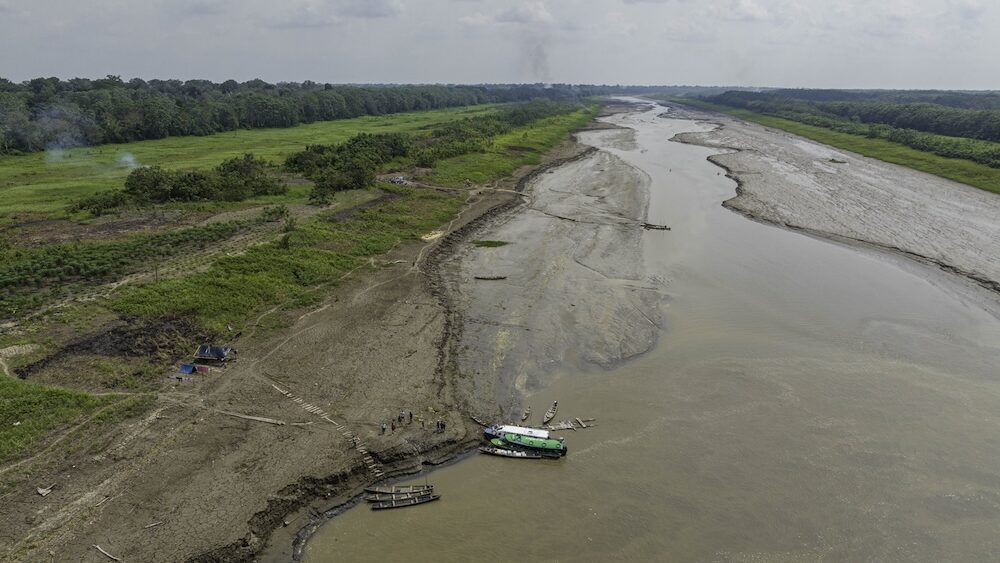
Last year alone, our planet lost more than 16.5 million acres of primary tropical forest—an area the size of Panama. For the first time on record, fire was the single biggest cause of primary tropical forest loss.4 Forest fires now destroy more than double the tree cover they did just twenty years ago.5 The Amazon, a rainforest once thought too wet to burn, is now becoming more flammable. Extreme drought has transformed swathes of the rainforest into tinderboxes, fueling fires that are bigger, hotter, more frequent, and far more destructive than anything the region has seen before.
Recent data shows that most Amazon fires are intentional. Deforestation and fires are used to clear land for industrial agriculture and cattle ranching. But with climate change exacerbating extreme drought conditions, these fires now spread faster and farther, releasing massive amounts of carbon stored in trees and soil. The result is a vicious cycle: Rising temperatures drive more fires, and fires accelerate climate change, pushing the world’s largest rainforest from being one of Earth’s greatest carbon sinks toward becoming a dangerous carbon source. In addition to fires and land deforested for industrial agriculture and cattle ranching, the Amazon is under relentless pressure from illegal logging, gold mining, and new roads that carve into the forest and allow criminal networks to invade Indigenous territories.
Last year it was extremely dry. There was no water, and what little remained was dirty. The fish in the river died. The drought lasted nearly five months, from July to November. It wasn’t like this before. We’ve been suffering for the last two years, and they say this year will be even worse.
– Jhuliana Sebastian Gomez,
Forest patroller and first woman leader of the San Francisco de Yahuma community, Peru
Meanwhile, countries across the Amazon basin and the world are dismantling environmental protections and rolling back climate policies. In the US, after the dissolution of USAID and the passage of the “One Big Beautiful Bill Act,” funding for critical climate programs, including support for forest protection in Central and South America, was slashed and essential support for Indigenous-led forest protection vanished.
In Brazil, a new law dubbed the “Devastation Bill” allows medium-impact projects, including most mining and agribusiness, to self-approve licenses online, with no prior impact studies or regulatory oversight. And in the lead up to COP30 in Belém, Brazil, the government again came under fire for approving exploratory drilling by state-owned company Petrobras near the mouth of the Amazon river, a decision that has raised the alarm within the Indigenous movement.6
Why does all of this matter? Because what happens in the Amazon affects us all. Without forests, we have no future.
Scientists have warned us for years that the Amazon is approaching a dangerous tipping point. Beyond it, large parts of the rainforest could begin an irreversible transformation into a degraded savannah, marked by sparse vegetation, widespread species extinction, and catastrophic consequences for Indigenous peoples who have lived in the forest for millennia. This transformation will also devastate our global climate and could be triggered if deforestation reaches 20–25%, and we’re already alarmingly close: 18% of the forest has already been lost.7
Indigenous-Led Solutions Keep Forests Standing
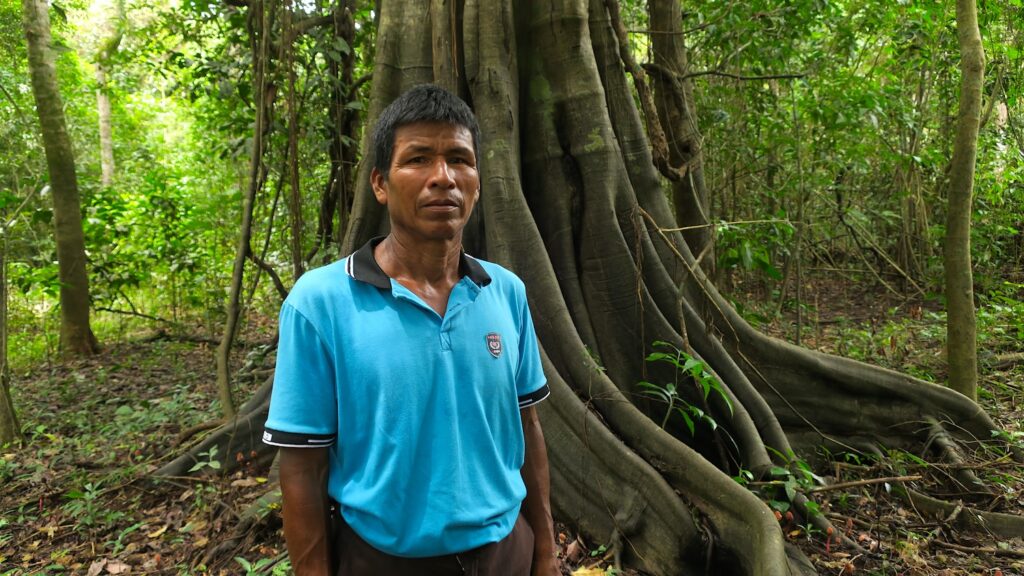
While the stakes are painfully high for rainforests, Indigenous peoples are leading the way and implementing impactful solutions to protect their forests, livelihoods, and cultures amid these growing threats.
Land Titling
To protect their lands, Indigenous communities need legal titles to their territories. A recent study found that forest cover loss dropped 66% after Indigenous communities secured legal rights to their lands. [2] However, securing land titles is a long, arduous process, historically taking a community decades. But in Peru, a new approach is changing that. By using a system of “titling brigades” that includes teams of soil analysts, lawyers, and Geographic Information System (GIS) specialists that RFUS funds and trains, Indigenous communities are now gaining legal titles to their ancestral lands at record speed.
In collaboration with local government and the Interethnic Association for the Development of the Peruvian Amazon (AIDESEP), RFUS supported Indigenous partners to secure 37 land titles covering 185,000 acres of rainforest between June 2023 and May 2024 in the Peruvian Amazon. In 2025, 16 more communities received legal titles to their ancestral lands, bringing the total to 53 communities that have secured land titles in just over two years. And this year, with the support of Rainforest Trust, and in partnership with AIDESEP, RFUS has launched a two-year project to secure rights to and protect approximately 550,000 acres of rainforest in the Chambira-Marañón region of Loreto.
It’s a mechanism for defense..with our new title, we will now be able to better protect our territory, and outsiders will no longer be able to cut down our forests for timber.
– Lenin Saúl Chávez Barbosa,
an Indigenous municipal agent of the Puerto Sinaí community
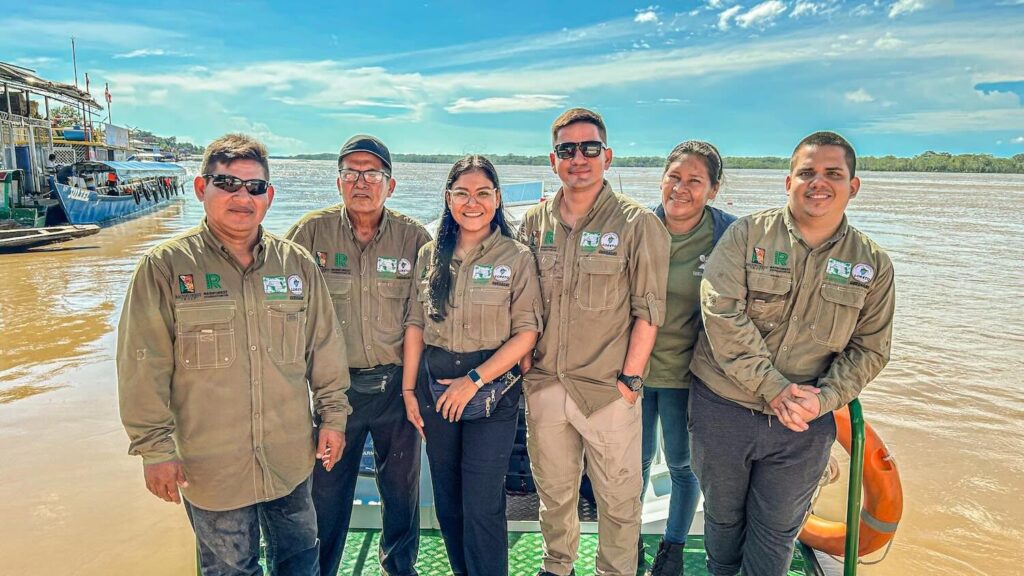
For decades, we have protected our territories without the necessary legal backing, without legal security. Titling means securing our future, defending our forest, and keeping alive the relationship we have always had with our ancestral lands.
– Jorge Pérez Rubio,
President of the Interethnic Association for the Development of the Peruvian Amazon (AIDESEP)
Community-Led Forest Monitoring
Securing Indigenous land tenure is essential, but land rights alone are not enough to protect rainforests. RFUS’s Indigenous partners are leading the way with community-based forest monitoring, using tools like smartphones, satellite alerts, and drones to detect and respond to threats such as illegal logging, mining, and criminal activity. This year, as a part of RFUS’s Rainforest Alert program, we supported Indigenous communities in monitoring and protecting 19.2 million acres of rainforest across Brazil, Peru, Guyana, and Panama, which proved invaluable in stopping encroaching threats in the Amazon.
This community-led approach is also backed by science. A peer-reviewed study found that communities using satellite deforestation alerts on smartphones experienced dramatically less forest loss than those without the technology. In the first year of the study, territories equipped with these tools saw 52% less deforestation than similar communities in the control group. In the second year, deforestation dropped by 21%.8
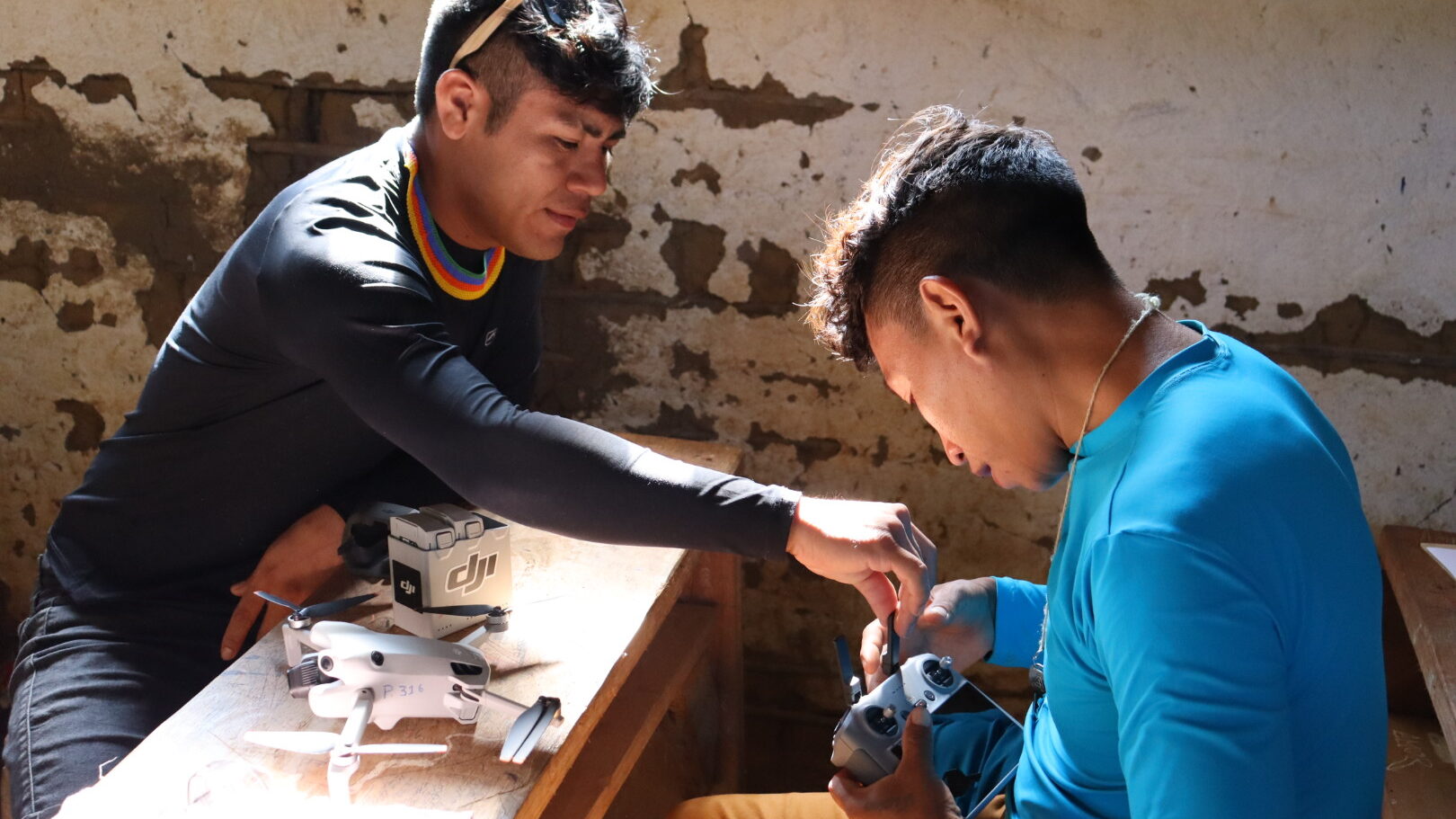
Within Indigenous territories, satellite data consistently shows lower rates of deforestation and ecosystem degradation, even more so when their lands are officially titled and consistently monitored. These areas demonstrate greater resilience to climate stress. Securing and expanding Indigenous land rights and community-led monitoring are measurable and effective strategies to maintain forest cover, protect hydrological cycles, and stabilize regional climate.
– Cameron Ellis,
Field Science Director, Rainforest Foundation US
Capacity Strengthening
In 2025, RFUS helped our Indigenous partners secure more than US$5 million in new funding from governments and private foundations. Facilitating this direct funding to our partners is urgent. Indigenous communities receive less than 1% of global climate finance despite managing and protecting 25% of our planet’s land. Most of the limited funding that does exist moves through intermediaries, facing delays, barriers, and bureaucratic roadblocks that prevent resources from reaching the communities on the frontlines of defending their territories. [9]
RFUS also partners closely with Indigenous organizations to strengthen governance, financial management, and technical systems, ensuring they can access, manage, and sustain major grants independently for the long term. This support is critical as the Indigenous peoples whose ancestral lands and livelihoods lie within these forests are owed the tools and resources needed to protect them while there is still time to act.
RFUS’s Role
We are entering the most decisive five years for the world’s tropical rainforests and our global climate. Protecting what remains is essential to humanity’s survival, and that future rests partly on securing the rights and leadership of the Indigenous peoples who have defended these forests for generations.
– Suzanne Pelletier,
Executive Director of Rainforest Foundation US
Within this urgency lies an extraordinary opportunity. In the next five years, RFUS and our Indigenous partners in Brazil, Peru, Guyana, Ecuador, Panama, and Mesoamerica will advance Indigenous peoples’ land rights across 14 million acres. We will also expand effective territorial monitoring across 91 million acres. And finally, we will strengthen 67 Indigenous and local organizations and increase their access to funding to deliver measurable, lasting impact. When Indigenous organizations are strong, they can confront new challenges, defend their lands, secure and manage more resources, and shape their own futures on their own terms.
This work is made possible through RFUS’s long-term partnerships with Indigenous organizations that are built on respect, trust, and collaboration. This partner-driven model ensures that resources reach those best equipped to protect rainforests. You can learn more about our 2030 plans here.
Double Your Impact to Protect Forests
We envision a world where the rights of Indigenous peoples are respected and rainforests flourish. What we do now, for rainforests and for the people who protect them, will shape the fate of our planet forever.
This winter, we have a rare opportunity. From now until December 31, a generous donor will be matching all gifts, $1-to-$1, to our $50,000 goal. Now is the perfect moment to support Indigenous communities to protect their forests and our climate. If you’re interested in making a matched gift now, you can do so here.
You can also double your impact while reducing your tax burden: We accept gifts from donor advised funds, stock donations, qualified charitable distributions from your individual retirement account, and crypto donations. It’s easier than you might think, and we’ve broken it down for you and provided quick tools on our Ways to Support page.
Thank you for everything that you do. You can learn more at www.rainforestfoundation.org/give, and if you have any questions, please don’t hesitate to reach out to [email protected]. We’d love to hear from you!
Sources:
- Ding, H., Veit, P. G., Blackman, A., Gray, E., Reytar, K., Altamirano, J. C., & Hodgdon, B. (2016). Climate Benefits, Tenure Costs: The Economic Case for Securing Indigenous Land Rights in the Amazon. World Resources Institute. https://files.wri.org/d8/s3fs-public/Climate_Benefits_Tenure_Costs.pdf?_gl=1%2A19t4vva%2A_gcl_au%2AMTg2NjAwNTk3Mi4xNzY0MDMxNDkx ↩︎
- Baragwanath, K., & Bayi, E. (2020). Collective property rights reduce deforestation in the Brazilian Amazon. Proceedings of the National Academy of Sciences of the United States of America, 117(34), 20495–20502. https://www.pnas.org/doi/10.1073/pnas.1917874117 ↩︎
- Veit, P., Gibbs, D., & Reytar, K. (2023, January 6). Indigenous Forests Are Some of the Amazon’s Last Carbon Sinks. World Resources Institute. https://www.wri.org/insights/amazon-carbon-sink-indigenous-forests ↩︎
- MacCarthy, J., Richter, J., Tyukavina, S., & Harris, N. (2025, July 21). The Latest Data Confirms: Forest Fires are Getting Worse. World Resources Institute. https://www.wri.org/insights/global-trends-forest-fires ↩︎
- Agence France-Presse. (2025, October 20). Brazil greenlights oil drilling in Amazon as environmentalists raise alarm. The Guardian. https://www.theguardian.com/world/2025/oct/20/brazil-greenlights-oil-drilling-amazon ↩︎
- Watts, J. (2025, June 26). ‘We are perilously close to the point of no return’: Climate scientist on Amazon rainforest’s future. The Guardian.
https://www.theguardian.com/environment/ng-interactive/2025/jun/26/tippping-points-amazon-rainforest-climate-scientist-carlos-nobre ↩︎ - Slough, T., Kopas, J., & Urpelainen, J. (2021). Satellite-based deforestation alerts with training and incentives for patrolling facilitate community monitoring in the Peruvian Amazon. Proceedings of the National Academy of Sciences of the United States of America, 118(29), e2015171118. https://doi.org/10.1073/pnas.2015171118 ↩︎
- Daley, J. (2018, July 23). Indigenous peoples manage one quarter of the globe, which is good news for conservation. Smithsonian Magazine. https://www.smithsonianmag.com/smart-news/indigenous-people-manage-one-quarter-globe-which-good-news-conservation-180969689/ ↩︎