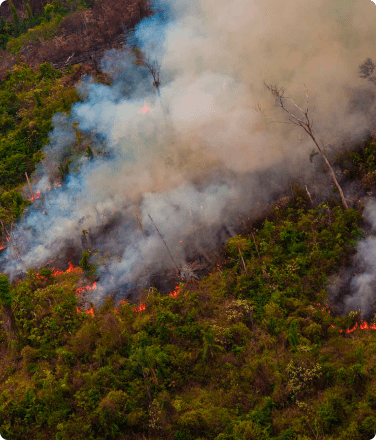
In 2025, the Brazilian Amazon experienced its lowest burned area since at least 2019, when MapBiomas Fire Monitor began tracking fires. Approximately 9.5 million acres (3.8 million hectares) of forest burned—an area roughly 50 times the size of New York City. While still alarming, this represents a dramatic 78.5% reduction compared to 2024, when fires affected 44.2 million acres and were the leading cause of forest loss across the world’s tropical primary forests.
This decline suggests progress, thanks in part to the end of El Niño-related drought and an increase in firefighting efforts across the Brazilian Amazon. Yet this progress is fragile. Sustaining it depends on continued political will in Brazil, and similar actions being taken across neighboring Amazonian countries. Otherwise, large-scale fires continue to pose a serious threat across the region.
In 2024, 44.2 million acres of Brazil’s Amazon rainforest burned, an area larger than California. This was a 66% increase from 2023, which saw 26.4 million acres burned, marking a 35.4% rise from 2022.
The crisis was not confined to Brazil in 2024. In Bolivia, fires scorched more than 2.47 million acres of forest, fueled largely by agricultural expansion—a nearly 114% increase over the previous record set in 2019. Peru endured its worst fire season on record, with most of the destruction occurring in primary forests. Venezuela, Colombia, Ecuador, and Guyana also reported major surges in fires.
While fires have temporarily declined in 2025, deforestation is soaring. Trees are being cleared for agriculture, mining, and roads, causing forest cover to shrink even in areas spared from fire. Combined with rising global temperatures and intensifying droughts, these trends are pushing the Amazon closer toward a tipping point, where it would start releasing more carbon than it absorbs.
Scientists warn that more than half of the Amazon could be at risk by 2050, with devastating consequences for biodiversity, regional weather patterns, and the stability of our global climate.
Tropical forests such as the Amazon are very humid, and under natural conditions, they rarely burn—unlike many forests in the western United States, where fire is a natural part of the forest’s life cycle.
In the last few decades, two interrelated phenomena have driven Amazon fires: drought, and the expansion of industrial agriculture.
Fire in the Amazon is often linked to land clearing for cattle ranching and farming. Traditionally, trees were cut, left to dry for months, and then set ablaze to prepare the land for pasture. The surrounding forest, still alive and moist, was wet enough to help contain the flames. But prolonged drought, fueled by climate change and deforestation, has changed that dynamic: fires now escape into neighboring primary forests, burning uncontrollably across thousands of acres. As the forest grows drier, fire itself has become both a tool and a dangerous “ally” for criminals, who take advantage of newly cleared areas to expand operations without having to do the clear-cutting themselves.
As forests are cleared and new roads are built, invaders gain access to more remote areas of the Amazon to clear new fields for cattle and agriculture. This creates a vicious cycle that both intensifies the drought and exposes more forests to fire and forest degradation. Scientists warn that this cycle is leading the entire Amazon basin towards a ‘tipping point,’ believed to occur when the combined effects of deforestation and degradation surpass a threshold of 20% to 25%. A study warns that the Amazon rainforest could reach this tipping point as early as 2050. If this happens, the world’s largest tropical forest would become so fragmented that it would no longer retain sufficient moisture to sustain itself, leading to catastrophic consequences for the global climate and life on Earth.
Climate change is intensifying fire activity across the world, with extreme heat waves now five times more likely today than they were 150 years ago. Hotter temperatures dry out forests, creating ideal conditions for larger, more frequent forest fires. These fires release carbon from trees and soil, contributing to a “fire-climate feedback loop” that worsens climate change.
Extreme fires around the world have dramatically weakened the ability of the world’s forests to absorb carbon. In recent years, forests absorbed only about a quarter of the carbon they normally would in an average year, with 2023 marking the lowest level in over two decades. Fires became the primary driver of forest-related emissions during this period, releasing over four gigatons of greenhouse gases annually, over 2 times the usual amount. This surge, combined with relentless deforestation and forest degradation, points to a troubling reality: the world’s forests are on the verge of becoming net carbon sources rather than sinks.
2024 was the hottest year ever recorded on Earth, increasing the Amazon’s vulnerability to fires. This year the region also experienced a historic drought for the second year in a row, fueling uncontrollable fires that spread through native vegetation. Low water levels in the region’s rivers made it difficult to combat the fires, leaving Indigenous and riverside communities isolated.
Annual Area Burned in Brazil’s Amazon (2019–2025)
Healthy forests don’t burn. And healthy communities manage and maintain healthy forests better than anyone.
Building on 35 years of steady, dedicated work with Indigenous partners in the Amazon and Central America, Rainforest Foundation US provides the tools, training, and resources to directly support in legal defense, land titling, and territorial monitoring. We also partner and collaborate with Indigenous peoples and local communities to strengthen their organizations. This enables them to continue to manage their lands with the knowledge and care that have sustained them for thousands of years.
Research consistently confirms that Indigenous peoples are the most effective forest stewards. Rainforests held by Indigenous peoples have fewer fires and lower fire temperatures, meaning they’re better able to resist forest loss. Data also shows that rainforests managed by Indigenous peoples contain greater carbon density than state-managed forests, and they foster higher levels of biodiversity. In other words, these forests are vital to our planet and play a crucial role in combating the climate crisis.
One of the best ways to protect the Amazon from fire, mining, industrial ranching, and illegal logging is to secure and expand the land rights of Indigenous peoples living in these territories. Indigenous peoples and local communities must have rightful governance and control over their territories, as well as access to the technology, training, and resources needed to manage them. Doing so is key to preventing fire and deforestation, and to protecting both biodiversity and cultural heritage in the region.
The satellite map below displays real-time fires and Indigenous peoples’ lands. The majority of fires are observed outside Indigenous’ territories, typically stopping at their boundaries.
Cameron Ellis
Field Science Director, Rainforest Foundation US
From 2001 to 2024, forests in Indigenous territories across the Amazon absorbed an amount of carbon equivalent to France’s annual fossil fuel emissions, while surrounding non-Indigenous lands were collectively a net carbon source. Ensuring that Indigenous peoples and local communities have the resources to protect their lands and secure land tenure is one of the highest-impact, lowest-cost investments for sustaining and strengthening forest carbon sinks.
Immediate action is needed to protect the Amazon. Protecting Indigenous lands is essential—not only for the peoples who call these forests home, but for the health of the planet and the stability of our shared future.
Discover the fascinating secrets of the Amazon!
Our new Kids’ Corner is full of new games, activities, and learning materials to help kids explore the rainforest—and see how they can help protect it.